A headless Commerce Operating System for India's scaling
enterprise D2C brands — designed from a blank canvas to a shipped MVP.
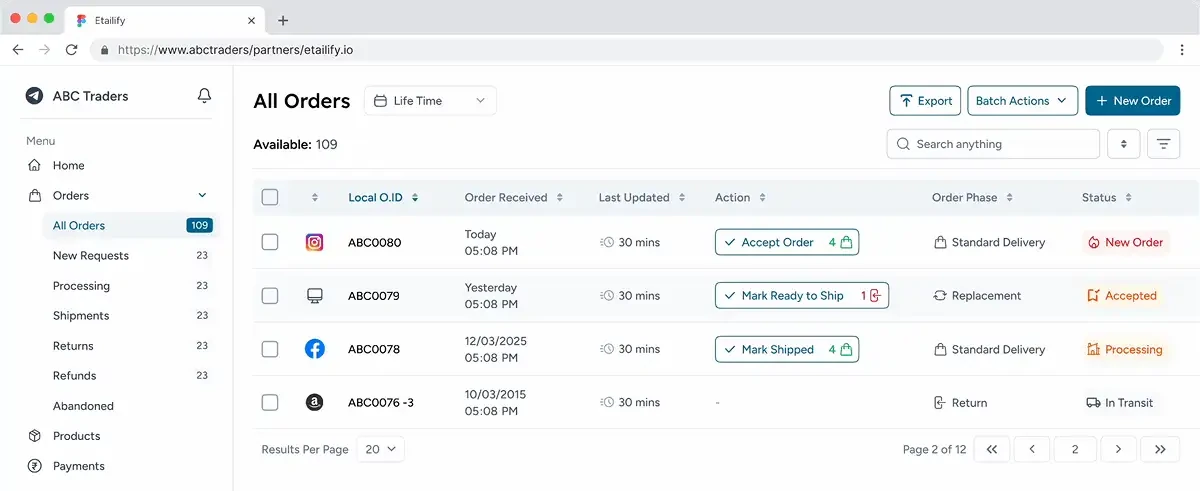
Partner OS · Order Management Dashboard
I joined with a commercial thesis and an engineering philosophy that did not yet agree on scope. My mandate was to translate both into a buildable, sellable platform before the runway ran out — operating simultaneously as researcher, strategist, information architect, and designer.
Three parallel research tracks before a line of code was written: undercover competitor procurement cycles with Shopify Plus and Unicommerce, embedded field research with brands at opposite operational ceilings, and USP definition against alternatives. The output was the commercial strategy and the product thesis — not a deck, but a buildable product vision.
Defined the complete structural blueprint across the entire Partner OS — catalogue architecture, supply chain logic, OMS state machines, fulfilment workflows, multi-node inventory transfers, and reverse logistics. Every IA decision mapped directly to the backend database states the CTO's pod would build against.
Designed every screen, interaction state, and edge-case resolution across all seven core systems — from the Maker-Checker pricing approval flow to the Twin Wallet payout UI. Produced a tokenised design system that the frontend engineer could execute with zero ambiguity.
Defined the MVP boundaries and held the line on scope every sprint. Forced a phased rollout when the founding team's instinct was to ship everything at once. Authored PRDs, state-machine specifications, and KT documentation that served as the single source of truth for engineering, BD, and onboarding simultaneously.
Did not own backend engineering execution, API protocols, database schema choices, hosting infrastructure, or carrier and payment gateway contract negotiations. Every commercial constraint was a variable to design around, not control. The boundary is documented here deliberately — because knowing where product ends and engineering begins is itself a design decision.
Three parallel research tracks run before a single line of code was written.
Four compounding operational failures — none individually fatal. The combination at volume was.
Tap any card to reveal the insight
Not gradual drifts — forced choices, each with a clear rationale, made before the build began.
(Forged through collective intelligence of the founding team.)
Tap any card to reveal the detail
Three non-negotiable constraints applied to every system on the roadmap. Each produced documented decisions to kill features that would otherwise have seemed reasonable.
Every feature evaluated against a single filter: does it directly protect or grow the merchant's operating margin? If not, it is cut.
Where a self-healing static model delivers 95% of the accuracy of a live API call at a fraction of the infrastructure cost, the static model wins.
Every system built as an independently activatable module — so the platform scales incrementally without requiring a full rebuild at each stage.
Seven core systems across two release stages — five shipped in the MVP, two fully designed and staged for post-onboarding activation. Select a layer to explore.
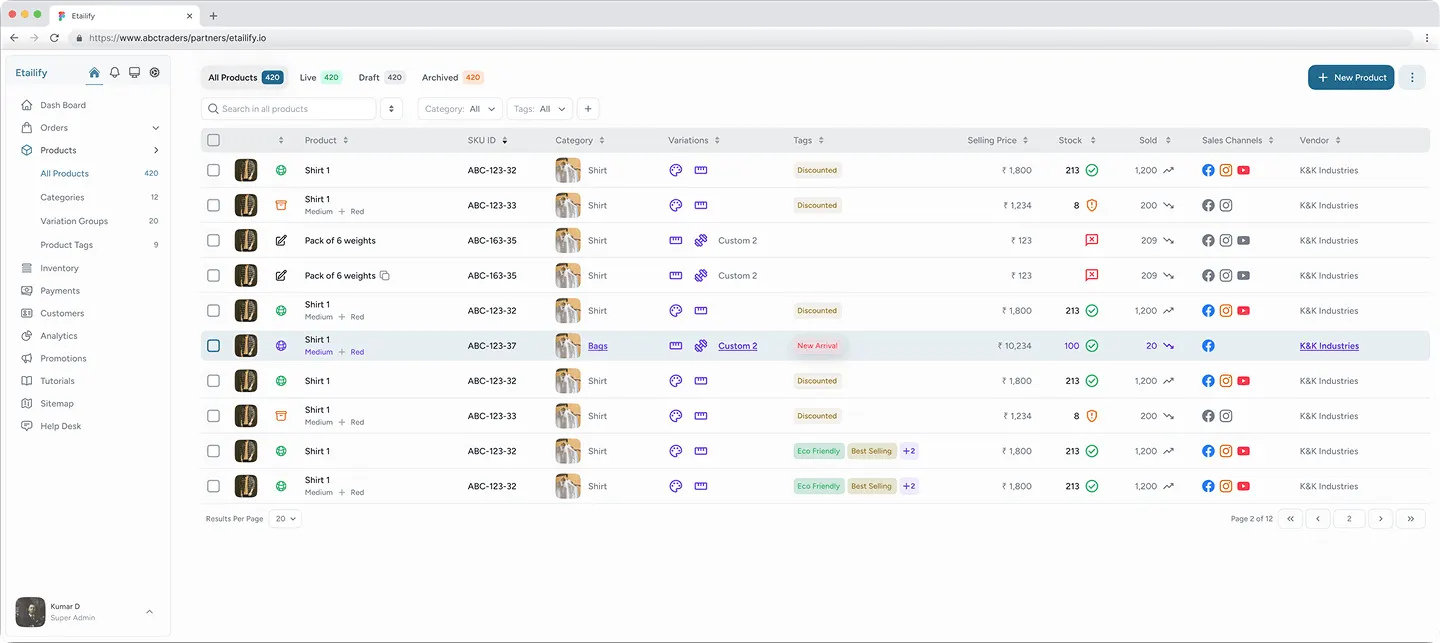
Decoupling the sellable frontend product from the physical backend SKU — a structural flaw in legacy platforms that breaks during bundle sales, B2B cross-listing, and multi-variant operations.
A complete OMS state machine — from order placement to post-delivery resolution — with granular intermediate states covering every conditional branching scenario.
The platform's transaction layer — engineered to execute the core commercial thesis of volume aggregation and spread capture. Activation is gated on Escrow infrastructure, not product readiness.
Moving beyond descriptive reporting. Cross-brand anonymised data becomes a prediction engine and the platform moat that compounds with every new merchant.
A modular UI framework that mirrors the decoupled backend — each micro-service independently toggleable without affecting global platform state.
A single module to demonstrate the structural logic required beneath the macro architecture. This state-machine schema ingests a raw storefront payload and autonomously triggers multiple carrier dispatches — zero manual intervention.
* System runs on self-healing static rate cards — eliminating live carrier API dependency and reducing infrastructure overhead by 90% with negligible routing accuracy loss.
Honest reflections from executing an enterprise OS with a 4-person founding pod. These are not lessons learned in theory — they are decisions that produced visible consequences on the build timeline.
I forced the pivot to a phased MVP — the right call. But continuous micro-additions throughout the build extended the timeline in ways that compounded before they were visible. Scope defence isn't a one-time decision; it's a weekly act of reviewing every addition against the defined core and making the trade-off explicit.
Carrier and PG negotiations moved slower than the build. Reprioritising was reasonable — but it compressed the QA window when contracts finally landed. The fix: sandbox carrier and PG endpoints from day one so engineering builds against dummy credentials throughout. Live keys swap in when BD closes. External timelines should never touch QA.
Next Steps
The deep product strategy, architectural trade-offs, and execution realities are best explored in a live conversation.